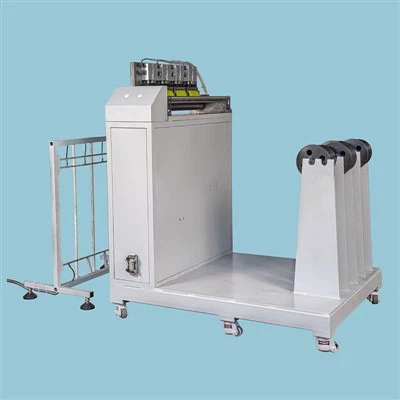
A fin forming machine is a crucial piece of equipment in the manufacturing industry, especially in sectors related to heat exchangers, air conditioning, and refrigeration systems. As a supplier of fin forming machines, I am excited to share with you how these remarkable machines operate.
1. Introduction to Fin Forming Machines
Fin forming machines are designed to transform flat metal sheets into fins with specific shapes and sizes. These fins play a vital role in enhancing the heat transfer efficiency of various heat exchange devices. Our company offers a range of fin forming machines, including the High - speed Fin Forming Machine, Long - life Fin Forming Machine, and Energy - saving Fin Forming Machine, each tailored to different production needs.
2. Basic Components of a Fin Forming Machine
2.1 Uncoiler
The process starts with the uncoiler. This component holds a large coil of metal sheet, typically aluminum or copper, which is the raw material for fin production. The uncoiler gradually unwinds the metal sheet, feeding it into the subsequent parts of the machine at a controlled speed. The tension of the uncoiler is carefully adjusted to ensure a smooth and consistent feed of the metal sheet.
2.2 Straightener
After the metal sheet is uncoiled, it passes through the straightener. The straightener is responsible for removing any curls or bends in the metal sheet. This is essential because a straight sheet is required for accurate fin forming. The straightener consists of a series of rollers that apply pressure to the metal sheet, gradually flattening it.
2.3 Punching Unit
Once the metal sheet is straightened, it enters the punching unit. This unit punches holes or slots in the metal sheet according to the design requirements of the fins. The holes or slots are used for various purposes, such as improving heat transfer or facilitating the assembly of the fins with other components. The punching unit is equipped with precision punches and dies, which are designed to create holes of the correct size and shape.
2.4 Forming Rolls
The forming rolls are the heart of the fin forming machine. These rolls are responsible for shaping the metal sheet into the desired fin profile. The forming rolls are designed with specific contours that gradually bend and shape the metal sheet as it passes through them. Different types of fin profiles, such as wavy fins, louvered fins, and serrated fins, can be produced by using different sets of forming rolls.
2.5 Cutting Unit
After the fin profile is formed, the metal sheet is cut into individual fins by the cutting unit. The cutting unit uses a sharp blade to make a clean cut at the appropriate length. The length of the fins can be adjusted according to the production requirements.
2.6 Stacking and Collecting System
The cut fins are then collected and stacked by the stacking and collecting system. This system ensures that the fins are neatly arranged and ready for further processing or packaging.


3. Operating Process
3.1 Machine Setup
Before starting the fin forming process, the machine needs to be properly set up. This includes adjusting the parameters of the uncoiler, straightener, punching unit, forming rolls, and cutting unit according to the specific requirements of the fin design. The operator needs to select the appropriate dies and forming rolls, and set the speed, pressure, and other operating parameters.
3.2 Loading the Metal Sheet
Once the machine is set up, the metal coil is loaded onto the uncoiler. The end of the metal sheet is then threaded through the straightener, punching unit, forming rolls, and cutting unit.
3.3 Starting the Machine
After the metal sheet is loaded, the operator starts the machine. The uncoiler begins to unwind the metal sheet, and the sheet passes through the various components of the machine in sequence. The punching unit punches the holes or slots, the forming rolls shape the fin profile, and the cutting unit cuts the fins to the desired length.
3.4 Quality Control
During the operation of the machine, quality control is essential. The operator needs to regularly check the quality of the fins, including the dimensions, shape, and surface finish. If any defects are found, the machine needs to be adjusted immediately to ensure the production of high - quality fins.
3.5 Maintenance
Regular maintenance is crucial for the proper operation of the fin forming machine. This includes cleaning the machine, lubricating the moving parts, and replacing the worn - out components. By performing regular maintenance, the machine can operate efficiently and have a longer service life.
4. Advantages of Our Fin Forming Machines
4.1 High - speed Operation
Our High - speed Fin Forming Machine is designed to produce fins at a high speed, which can significantly increase the production efficiency. This is especially beneficial for large - scale production.
4.2 Long - life Performance
The Long - life Fin Forming Machine is built with high - quality materials and advanced manufacturing techniques, ensuring a long service life. This reduces the cost of equipment replacement and maintenance.
4.3 Energy - saving Design
Our Energy - saving Fin Forming Machine is designed to consume less energy while maintaining high - performance operation. This not only reduces the operating cost but also contributes to environmental protection.
5. Conclusion and Call to Action
In conclusion, fin forming machines are complex and sophisticated pieces of equipment that play a crucial role in the manufacturing of heat exchangers and related products. Our company, as a professional fin forming machine supplier, is committed to providing high - quality machines with advanced technology and excellent performance.
If you are interested in our fin forming machines or have any questions about their operation, applications, or customization, please feel free to contact us for a detailed discussion. We are looking forward to working with you to meet your production needs and achieve mutual success.
References
- Smith, J. (2018). Handbook of Heat Exchanger Design. Elsevier.
- Brown, A. (2020). Manufacturing Processes for Metal Products. Wiley.