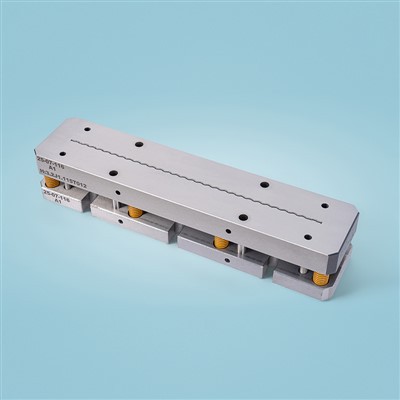
Fin forming machines in the heat exchanger manufacturing field are not of a single type. They exhibit many differences based on their structural principles, forming methods, drive mechanisms, and applicable scope. These differences directly affect the equipment's processing capacity, production efficiency, and suitability for various scenarios. Understanding these differences helps companies select machines that match their specific process requirements.
From a structural principle perspective, the common differences lie in the two types of machines: roll forming and stamping forming. Roll forming machines use continuous roller sets to press out fin waveforms segment by segment. The roll material can be fed without stopping the machine, making it suitable for mass production of long, strip-shaped fins. Its advantages are high speed and strong continuity. Stamping forming machines, on the other hand, use a die and a punch press to press out the fin shape in one go. They are suitable for fins with complex structures or those requiring simultaneous punching. Their advantages are high dimensional accuracy and the ability to form multiple features in one operation, but the cycle time is relatively slow, making them more suitable for small to medium batches or special specifications.
The differences in drive mechanisms are also significant. Traditional rolling mills typically employ mechanical transmissions combined with clutches and speed control gearboxes, resulting in simple structures and lower costs, but limitations in speed adjustment and precision control. Modern rolling mills generally incorporate servo motors and CNC systems, enabling independent speed control and closed-loop positioning for each roller group. This not only improves forming accuracy but also allows for rapid switching of product parameters, offering far greater flexibility than older models. The difference in user experience manifests in the former's reliance on experience and time-consuming changeovers, while the latter allows for programmed execution and rapid response.
The difference in application scope primarily lies in the materials and product types. Roll forming mills, due to their continuous forming characteristics, are better suited for handling lightweight metals with good ductility, such as aluminum and copper foil, and are widely used in evaporator and condenser fins for air conditioners and refrigerators. Stamping mills, with their highly malleable molds, can handle thicker or irregularly shaped materials, and are commonly used in automotive radiators, engineering machinery cooling modules, and other applications requiring special strength and shape. Furthermore, roll forming mills facilitate continuous production of ultra-long fin strips, while stamping mills are more flexible in forming complex single-piece structures.
The difference in automation level is also noteworthy. Some high-end roll forming machines are equipped with automatic unwinding, leveling, online inspection, and fixed-length cutting, and can be connected with upstream and downstream equipment to form fully automated production lines. While stamping presses also have automatic feeding and unloading, the increased cycle time and mold changes make them more difficult to integrate into production lines, often existing as stand-alone machines or short-range semi-automatic lines. Differences in automation levels translate to different performance in terms of labor costs and production capacity stability.
The differences in size and footprint are equally significant. Roll forming machines, requiring continuous roller conveyors and longer frames, typically occupy more space and have a longer, narrower shape; stamping presses, especially small benchtop presses, have a compact structure and can be deployed in limited spaces, making them more suitable for workshops or R&D/prototyping environments with limited space.
Fin forming machines each have their own characteristics in terms of structural principles, drive systems, material compatibility, automation levels, and footprint. Roll forming machines excel in high-speed continuous operation and lightweight material processing, while stamping presses are better suited for complex shapes and thick material forming. Only by recognizing these differences can we make practical choices in equipment configuration and process planning, so as to achieve the best match between machine performance and product requirements.