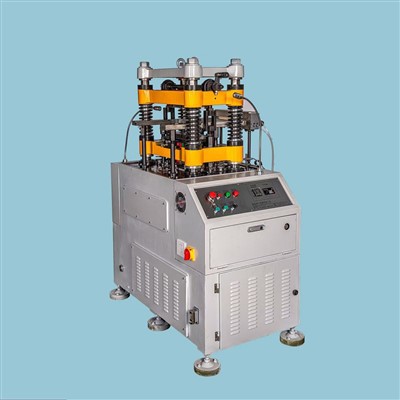
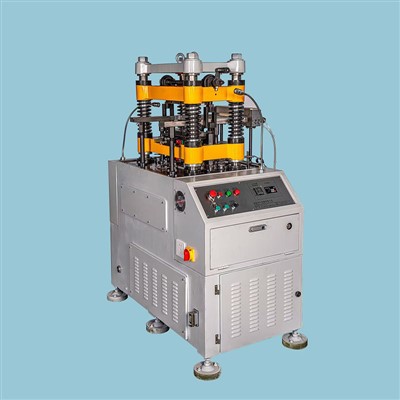
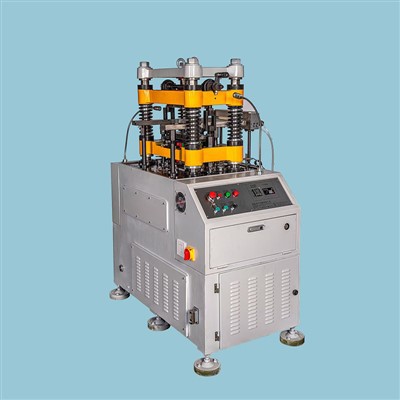
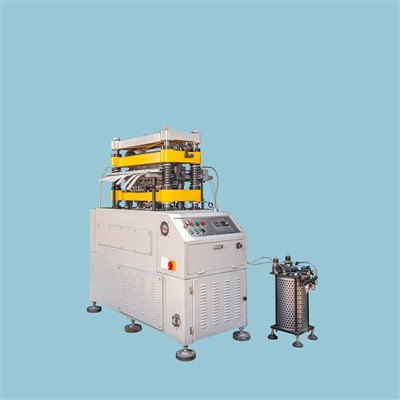
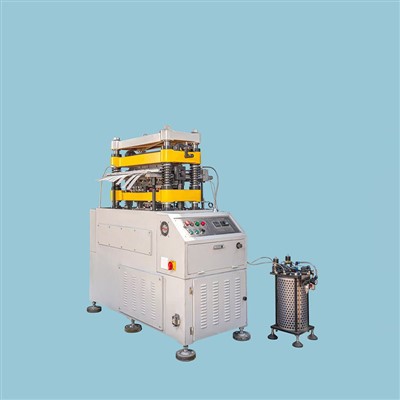
The design principle of a servo cutting machine is based on a servo motor as the power core. Through precise closed-loop control of position and speed, it achieves high-precision and highly flexible cutting of materials.It organically combines mechanical transmission, electronic control, and sensor feedback, enabling the cutting process to possess both rapid response and stable repeatability, thus meeting the stringent requirements of modern manufacturing for fixed-length and shaped cutting.
The core of the design lies in the matching of power and control. The servo motor can adjust its speed over a wide range and output high torque at low speeds, providing a stable power source for cutting materials of different materials and thicknesses. The rotational motion output by the motor is converted into linear motion via a ball screw or synchronous belt, driving the cutter forward or backward along a predetermined trajectory. Because the servo system has a built-in encoder, it can detect the rotor position in real time and feed it back to the controller, forming a closed-loop adjustment. This ensures that the cutter can remain at the set position even under high-speed or variable-load conditions, with errors controlled within a very small range. This design eliminates the coarse positioning method of traditional clutches and limit switches, realizing digital and programmable motion control.
The design of the transmission mechanism directly affects the smoothness and accuracy of the motion. Ball screws, due to their low friction, high transmission efficiency, and controllable backlash, are commonly used in machines with strict positioning requirements. Synchronous belts perform well in light-load, high-speed scenarios, offering a simpler structure and easier maintenance. The selection of guide rails and sliders must balance rigidity, wear resistance, and guiding accuracy to ensure no misalignment or vibration during repeated motion. The design of the cutting blade assembly must consider the mechanical properties of the material being cut, such as the blade type and installation method for different cutting methods like shearing, sawing, or hot cutting, ensuring uniform force distribution when the blade contacts the material for a smooth cut.
The control system's design principle integrates human-machine interaction, motion algorithms, and safety assurance. The operator inputs parameters such as cutting length, speed, and quantity via a touchscreen or host computer. The control system generates motion curves based on these instructions and calculates acceleration, constant speed, and deceleration phases, enabling the cutter to complete positioning and return in the shortest possible time. To cope with fluctuations in feed speed or material elastic rebound, the system collects position and speed feedback in real time, dynamically adjusting the output to maintain synchronization between the cutting rhythm and the production line cycle. Safety features include travel limits, overload protection, and emergency stop circuits, enabling rapid power cut-off in abnormal conditions to prevent equipment damage and personnel injury.
Modern servo cutting machines also incorporate intelligent and modular design concepts. The modular structure allows for the customizable combination of transmission, drive, cutting, and clamping units to adapt to different processing needs. Intelligent functions such as data acquisition, fault diagnosis, and remote monitoring upload operating parameters and status to an information system, providing a basis for process optimization and predictive maintenance. Some models support linkage with upstream and downstream equipment, achieving synchronous control via bus or industrial Ethernet, making the cutting process a precise and reliable logistics node in the automated production line.
Overall, the design principle of servo cutting machines is to achieve high-speed, high-precision, and flexible cutting operations based on precise power supply, stable and efficient transmission, and intelligent closed-loop control. It deeply integrates the rigidity of mechanical engineering with the flexibility of electronic control, ensuring the quality of each cut while giving the equipment the adaptability to multi-variety production, thus becoming an important technological carrier for improving processing levels and logistics efficiency in modern manufacturing.