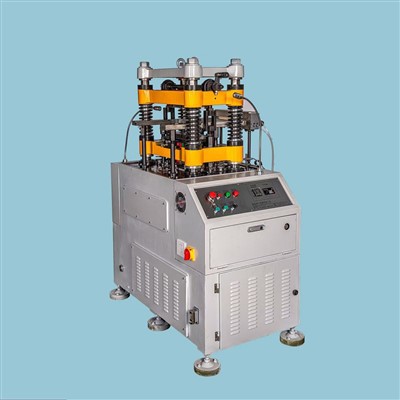
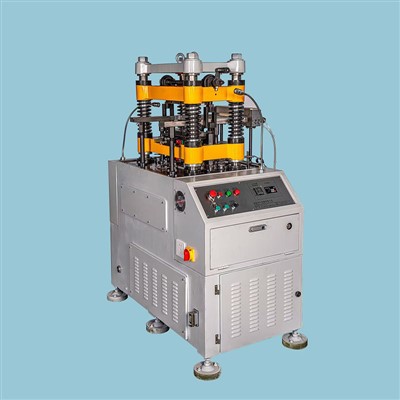
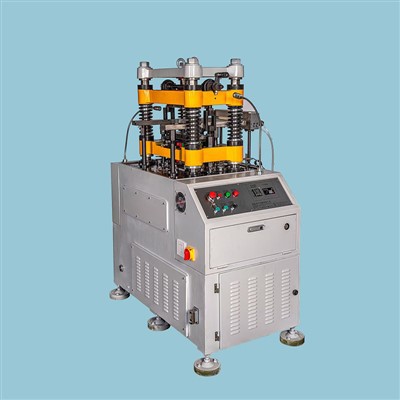
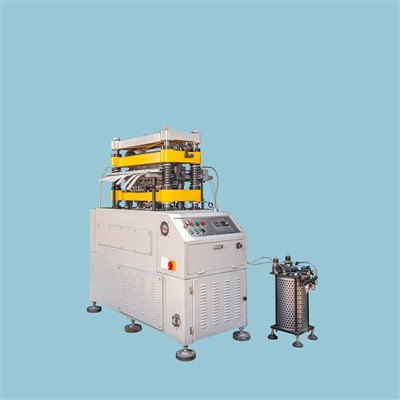
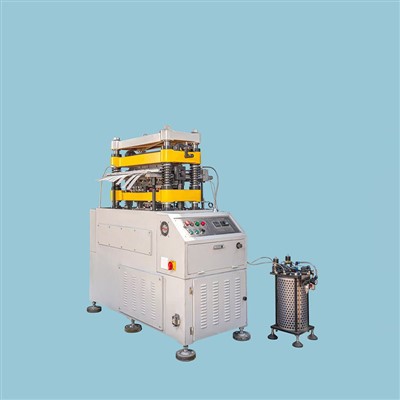
The composition of a servo cutting machine refers to the scientific layout and integration of various mechanical, electrical, and control components based on its functional and performance requirements, forming a complete system capable of high-precision and high-efficiency cutting operations. It is not simply an assembly of parts, but rather a process of structural design and process matching that allows each part to work collaboratively, ensuring both precise movement and stability and maintainability. Understanding its composition helps in grasping key aspects during selection, assembly, and improvement.
The main frame is the foundation of the machine, typically welded or cast from high-rigidity steel. After aging treatment to eliminate residual stress, it undergoes precision machining to achieve the required flatness and perpendicularity. The frame not only supports the guide rails, lead screws, and transmission mechanisms but also provides a stable base for the entire machine, resisting vibration and deformation. In terms of layout, the drive zone, cutting zone, and feeding zone are arranged according to the process flow sequence, shortening the motion path and reducing mutual interference, creating conditions for high-speed operation.
The motion execution part consists of a servo motor, transmission mechanism, and guiding components. The servo motor, as the power source, can achieve precise speed and angle output according to control commands, and form a closed-loop feedback through an encoder. The motor's output is transmitted to the ball screw via a coupling or synchronous belt, converting the rotary motion into linear motion, driving the cutter to reciprocate along the guide rail. The guide rail is usually a high-precision linear guide, constraining the direction of motion and providing low-friction, high-rigidity support, ensuring the cutter maintains a stable trajectory during high-speed acceleration and deceleration. The fitting accuracy between the ball screw and the guide rail directly affects the repeatability of positioning and the consistency of the cutting length.
The cutting mechanism is the core unit for completing the machining process, generally composed of a cutter, a tool holder, and a drive unit. The cutter material is selected according to the workpiece, such as high-speed steel or tungsten steel. The tool holder ensures secure installation and easy replacement. The drive unit can be a cylinder, a hydraulic cylinder, or directly driven by an additional servo motor, rapidly closing and retracting according to control signals to achieve instantaneous cutting and reduce heat-affected zones and deformation. The design considers blade clearance, clamping force, and retraction speed to avoid workpiece displacement or rough cut edges.
The control system translates operational commands into the action logic of each component. It consists of a human-machine interface, a programmable logic controller (PLC), servo drives, and various sensors. The operator inputs cutting parameters on the upper-level interface; the controller calculates and generates position and speed curves according to the program; the drive controls the motor operation accordingly; and the sensors monitor position, speed, and limit status in real time and provide feedback, forming a closed-loop control system to ensure accuracy and safety. For multi-specification or multi-process processing, recipes can be stored and recalled, reducing manual intervention and improving consistency.
The auxiliary system covers feeding, positioning, safety protection, and cooling/lubrication. The feeding mechanism delivers the workpiece to the cutting area at set intervals; the positioning device ensures consistent cutting starting points each time; protective covers and emergency stop devices ensure personnel safety; and the lubrication system periodically supplies the guide rails and lead screws with appropriate amounts of grease to reduce wear and maintain smooth movement. The electrical cabinet centrally houses the drive and control components and is designed for dustproofing, moisture protection, and heat dissipation to improve reliability.
Overall, the servo cutting machine is constructed using a rigid frame as its foundation, servo drives and linear transmissions for precise movement, a dedicated cutting mechanism to complete the processing task, and an intelligent control system to coordinate the entire machine's operation, supplemented by necessary feeding and safety features. This modular and clearly defined functional design gives the equipment high precision, high efficiency, and ease of maintenance, allowing it to flexibly adapt to the production needs of different materials and batch sizes.