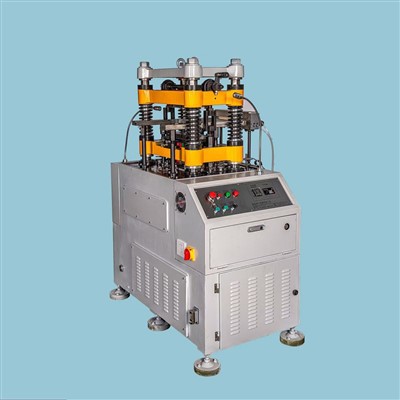
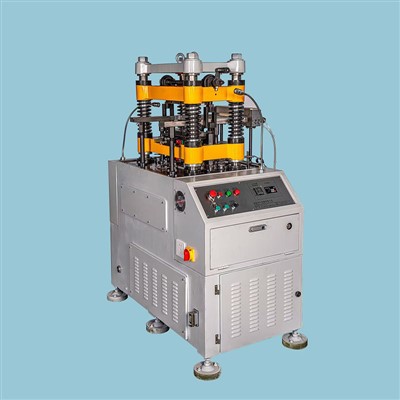
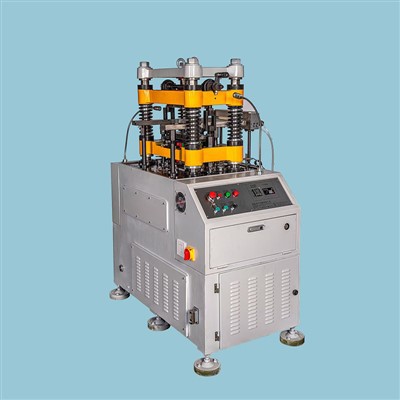
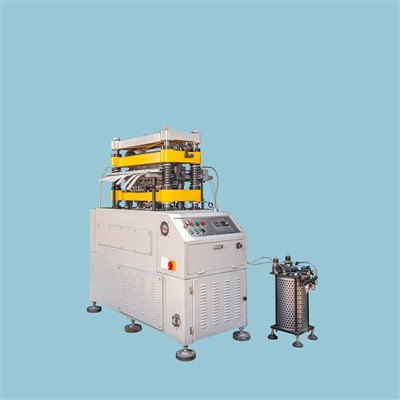
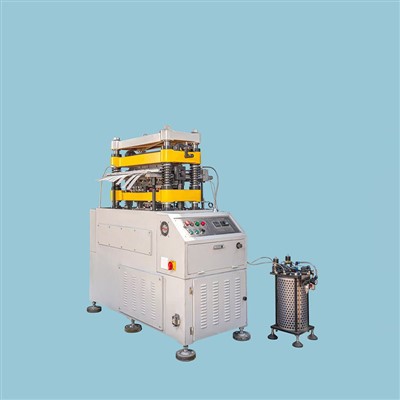
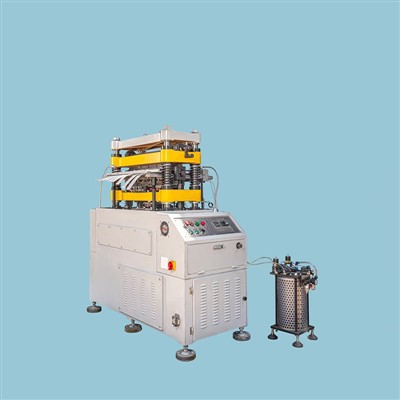
The design principle of automatic feeders revolves around achieving a stable, precise, and controllable supply of materials in continuous production. It organically combines mechanical transmission, power control, sensing and detection, and system integration, enabling the equipment to adapt to diverse working conditions and seamlessly connect with downstream processes.Understanding this principle helps in grasping the functional emphasis and performance boundaries of different models, and also provides a clear direction for selection and improvement.
From an overall structural perspective, the design of automatic feeders primarily follows the principle of "on-demand distribution and smooth transition." The mechanical part consists of a storage unit, a conveying and guiding mechanism, and a drive and execution mechanism. The storage unit adopts a roll, disc, or stacked layout depending on the material shape, and ensures continuous material supply within a limited space through lifting, rotating, or interchangeable mechanisms. The conveying and guiding mechanism is responsible for transitioning the material from static storage to uniform forward movement. Commonly used methods include rollers, guide rollers, conveyor belts, or vacuum adsorption surfaces. The contact method is selected based on the rigidity, flexibility, and surface characteristics of the material to reduce deformation and scratches. The drive actuator converts power into controllable linear speed or feed rate, which is the core of maintaining the feeding rhythm.
The power and control principles emphasize closed-loop regulation and dynamic matching. Traditional models often use direct drive with a motor and reducer, while modern designs increasingly incorporate servo systems and programmable controllers to achieve real-time closed-loop control of speed, position, and tension. Sensors collect information such as roll diameter, running speed, and load changes, feeding it back to the controller for calculation. The drive unit then fine-tunes the output, ensuring constant speed and tension during the feeding process under different operating conditions. This closed-loop logic is particularly suitable for roll materials, offsetting the inertial effects caused by reduced roll diameter or acceleration/deceleration, preventing material stretching, wrinkling, or breakage.
Tension control is a critical aspect of the design. Its principle is to ensure the material experiences appropriate and stable tension throughout the conveying process. Magnetic powder brakes, pneumatic constant tension devices, or servo direct drives are commonly used to precisely apply resistance or driving force, forming a feedback loop in conjunction with tension detection elements. For easily ductile materials, the base tension can be reduced and buffer zones can be set; for brittle materials, peak tension must be strictly controlled to prevent instantaneous overload. Multiple material parameter templates are pre-configured in the design for quick switching to adapt to different batches.
The sensing and detection principles endow the equipment with the ability to "see" and "judge." Photoelectric sensors detect material level and edge position, proximity switches capture mechanical limits, encoders provide displacement and speed feedback, and vision systems can identify marks or defects and guide automatic alignment. This information is fused and processed in the control system, triggering not only protective actions such as material changing, correction, or speed reduction, but also linkage with the production management system to achieve raw material consumption statistics and process cycle synchronization.
The system integration principle focuses on overall smoothness. The automatic feeding machine is not an isolated node, but communicates with the feeding warehouse, batching unit, and subsequent processing equipment through standardized interfaces to achieve data exchange and coordinated actions. Bus or Ethernet interfaces are reserved in the design to support access to industrial IoT platforms, enabling remote monitoring of operating status and predictive maintenance. The structural layout also considers human-machine interaction convenience, placing the control panel, warning lights, and emergency stop device in easily accessible locations, balancing safety and efficiency.
Therefore, the design principle of the automatic feeding machine is to achieve stable conveying, based on mechanical load-bearing capacity, using closed-loop control, relying on sensing and detection for assurance, and extending value through system integration. This allows the equipment to be both reliable and flexible in various production scenarios, becoming a crucial hub for the efficient operation of automated production lines.