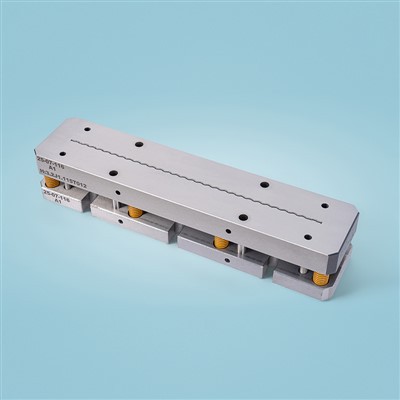
The main materials used in servo cutting machines are key factors determining their structural strength, durability, precision retention, and adaptability to the working environment. It's not simply a matter of piling up single materials, but rather a combination of materials with distinct advantages selected based on the working load and environmental conditions of different functional parts. This ensures stable performance during high-speed, high-precision, and long-term operation. Understanding the characteristics of these materials helps in making more informed decisions when purchasing, maintaining, and improving equipment.
The machine body and frame are typically made of high-quality carbon structural steel or low-alloy high-strength steel. These types of steel possess excellent tensile strength and rigidity, resisting deformation under the reaction forces and vibrations generated during cutting, thus providing a stable mounting base for precision components such as guide rails and lead screws. To balance ease of processing and cost control, the frame blank is often welded or cast, then aged to eliminate internal stress, and precision milling or gantry machining centers are used to ensure flatness and perpendicularity, guaranteeing the overall geometric accuracy of the machine from the outset.
Guide rails and sliders are mostly made of high-carbon chromium bearing steel or alloy tool steel that has undergone quenching. These materials have high hardness and good wear resistance, maintaining a smooth contact surface for a long time and reducing creep and backlash changes during movement. Some high-end models will apply plastic coating or plating to the guide rail surface to further improve corrosion resistance and low friction performance, making them suitable for dusty or humid environments. The rolling elements of the slider usually use high-purity bearing steel balls or rollers, combined with a precision cage, to ensure smooth and stable operation even at high speeds.
The choice of materials for the lead screw and nut assembly directly affects positioning accuracy and transmission rigidity. A common practice is to use carburized or induction-hardened medium-carbon alloy steel for the lead screw to achieve high surface hardness and wear resistance, while maintaining a certain degree of toughness in the core to resist impact. Nuts are mostly made of tin bronze or engineering plastics; the former has strong load-bearing capacity and a stable coefficient of friction, while the latter reduces operating noise and is self-lubricating, suitable for light loads or applications requiring high cleanliness. For equipment with higher precision requirements, pre-tensioned lead screws are also used to compensate for elongation errors caused by temperature rise.
As the part that directly contacts the workpiece, the cutting blade must be made of a material that combines hardness, wear resistance, and a certain degree of toughness. High-speed steel is a common choice, as it maintains sharpness under moderate loads and can be re-sharpened multiple times. For cutting hard metals or high-strength composite materials, tungsten steel or cobalt-containing high-speed steel can be used; these materials have higher hardness and better red hardness, which can delay edge wear. Some special-purpose cutting blades are also coated with wear-resistant coatings to further extend their service life and improve the cut surface quality.
Key components of the transmission system, such as the servo motor housing, often use die-cast aluminum, which is both lightweight and facilitates heat dissipation. Couplings and pulleys are mostly made of aluminum alloy or stainless steel; the former is lightweight and has low rotational inertia, while the latter has excellent corrosion resistance, making it suitable for humid or chemical environments. The electrical control box casing generally uses cold-rolled steel sheet with anti-corrosion paint, providing both electromagnetic shielding and mechanical protection.
Overall, the material selection for servo cutting machines follows the principle of "prioritizing the stress and function of the parts," achieving a balance between rigidity and toughness, wear resistance and corrosion resistance, and lightweight design and heat dissipation. A reasonable combination of materials not only gives the equipment reliable mechanical performance, but also enables it to maintain stable precision and a long service life in different processing scenarios, thus becoming a powerful support for efficient production.