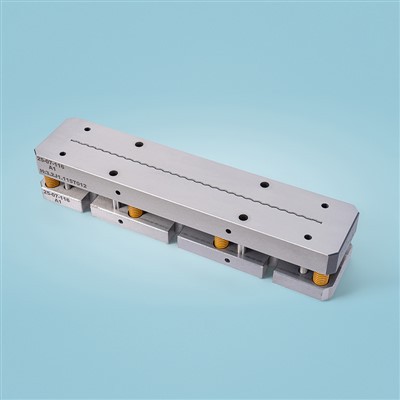
The working principle of a servo cutting machine is to utilize a servo drive system to perform high-precision position and speed control on moving parts, enabling the cutter to cut the workpiece to a fixed length or shape according to a preset path and rhythm.It organically combines mechanical transmission, electrical control, and information processing, converting digital signals from operating commands into repeatable, precise actions, thereby meeting the comprehensive requirements of modern processing for efficiency, precision, and stability.
The core of the machine lies in the servo control system. After the operator inputs parameters such as cutting length, speed, and quantity on the upper interface, the control system converts these values into position commands and transmits them to the servo driver. The driver generates corresponding current and voltage waveforms based on the commands, driving the servo motor to rotate. The motor, through a coupling or synchronous belt, drives the transmission mechanism, converting the rotational motion into the linear displacement of the cutter. Compared to traditional stepper or ordinary motors, servo motors have closed-loop feedback functionality. The motor has a built-in encoder or uses an external encoder to detect the rotor position in real time and sends the signal back to the driver for comparison and correction. This allows for rapid adjustment of the output even in the event of load fluctuations or external interference, ensuring the actual position closely matches the target value.
The transmission mechanism is the key component for achieving precise displacement. Common configurations include ball screws, linear guides, and rack and pinion systems. The ball screw precisely converts the motor's rotation into linear motion; the circulating balls within its helical pair significantly reduce friction, improving transmission efficiency and positioning rigidity. The linear guide constrains the direction of motion and provides low-resistance, high-rigidity support, ensuring smooth operation of the cutter during high-speed reciprocating motion. The rack and pinion system functions when longer strokes or high-inertia loads are required. The entire transmission chain is designed to maintain sufficient rigidity under high-speed acceleration and deceleration conditions, minimizing the impact of elastic deformation and backlash on accuracy.
The cutting action is executed jointly by position triggering and tool control. When the cutter moves along the guide to the set position, the control system sends a positioning signal, triggering the cutter drive device-which may be a cylinder, hydraulic cylinder, or a servo motor directly driving the cutter shaft-to complete rapid closing and cutting. Subsequently, the system moves the cutter back to the starting point or the next station at the set return speed. During this process, buffer control can mitigate start-stop impacts, protecting the mechanical structure and workpiece surface quality. For multi-segment cutting or machining of complex contours, the control system can plan multi-axis linkage paths, allowing the cutter to move along a predetermined trajectory in space, achieving multiple machining operations in a single setup.
A detection and feedback mechanism is implemented throughout the entire operation. Limit switches, origin sensors, and encoders form a multi-layered safety and calibration network to prevent overtravel and loss of synchronization, and automatically return to zero upon each startup or recovery from an anomaly, ensuring coordinate system consistency. Some models are also equipped with force or torque monitoring to identify cutter obstruction or material abnormalities, allowing for timely shutdown to prevent equipment damage or workpiece scrap.
Overall, the working principle of the servo cutter starts with digital instructions, using servo drives, precision transmission, and real-time feedback to form a closed-loop control system, enabling the cutter to complete high-quality cuts in high-speed, controllable motion. This principle ensures both repeatability and programmable flexibility, while also giving the equipment the ability to adapt to various materials and process requirements, making it an indispensable and efficient machining unit in modern automated production lines.